Our Philosophy
Be a good manager, and an even better employee.

Modern knowledge workers are drowning in meta-work. Entire industries exist to help us categorize, color-code, nest, and re-estimate our to-do lists. We spend hours designing elaborate project dashboards, convincing ourselves that organizing work is the same as accomplishing it. We have become world-class managers of our own lives—and deeply exhausted, ineffective employees.
A pristine list of fifty nested tasks does not provide clarity; it creates cognitive paralysis. At some point in the day, the managerial planning must stop, the conceptual map must be locked, and the solitary craft of execution must begin. Owldo is built to turn potential energy into kinetic momentum.
Tasks as RAM, Notes as ROM
In computer architecture, Random Access Memory (RAM) holds the immediate instructions being processed by the CPU right now, while Read-Only Memory (ROM) and disk storage hold vast archives for retrieval. Most productivity systems fail because they treat tasks like infinite archives.
In Owldo, tasks are treated strictly as working RAM: volatile, urgent, and focused solely on what needs to happen today. Notes, documents, and reference materials are ROM: durable context that sits quietly in the background until summoned. Conflating the two creates an unmanageable hybrid that overwhelms daily action.
The 37% rule and optimal stopping in daily productivity
Drawing on computer science and mathematical optimal stopping theory, the exploration phase must naturally yield to the exploitation phase. Roughly 37% of effort should be allocated to scoping, gathering requirements, and outlining—with the remaining 63% dedicated to continuous, uninterrupted execution.
When software makes planning too modular or entertaining, people fall into infinite exploration. Owldo intentionally limits cosmetic tweaking so you can hit optimal stopping and transition effortlessly into doing the actual work.
Bridging the intent-action gap with focused constraints
Parkinson's Law states that work expands to fill the time available for its completion. Without rigid temporal boundaries, an ambiguous two-hour task easily sprawls across an entire afternoon.
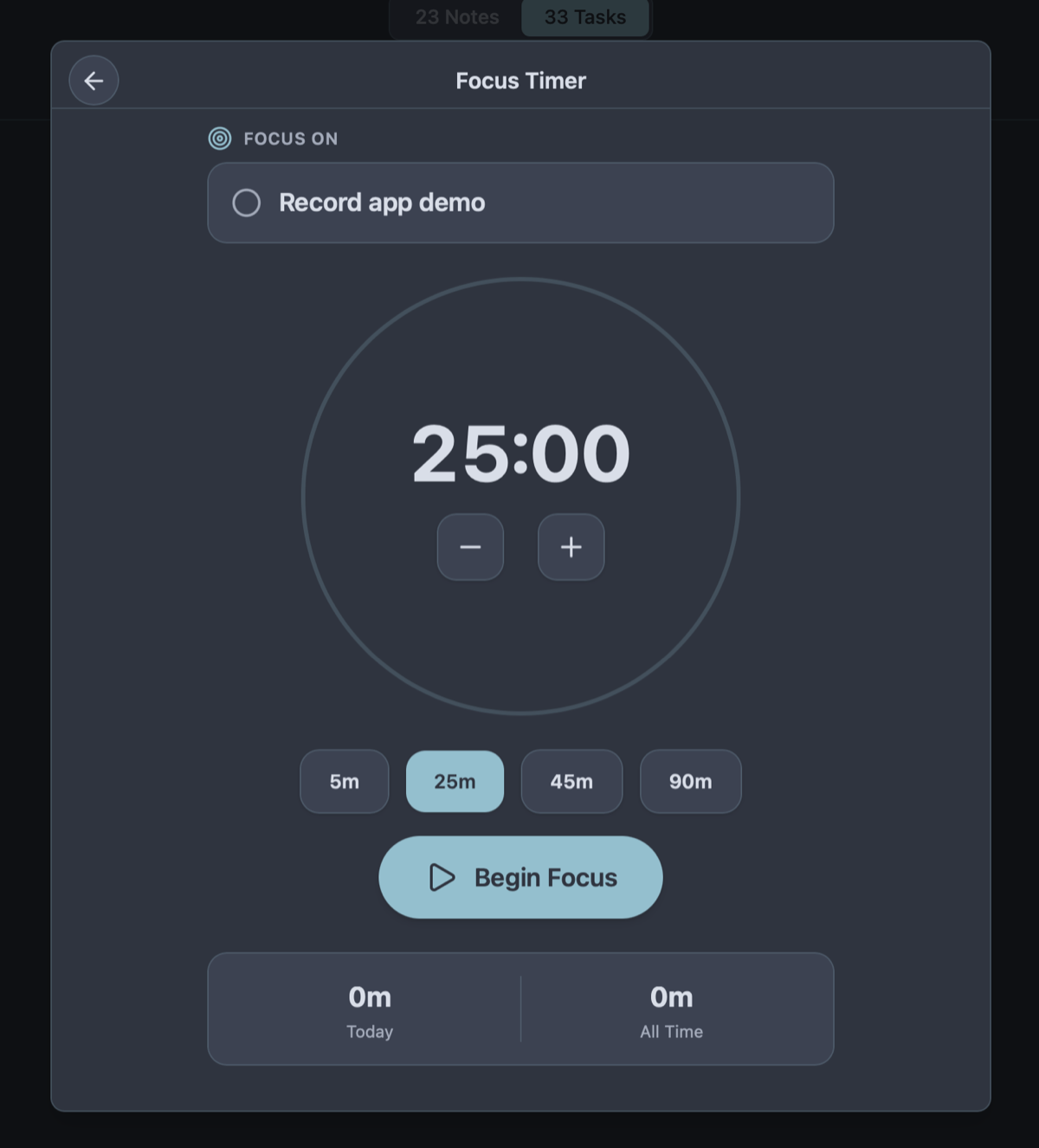
Owldo embeds native focus timers (Pomodoro intervals) directly beside your active tasks. When you switch into "employee mode," the interface strips away extraneous sidebars and nested hierarchies, presenting only the single objective and a running clock to protect your attention.
Combating attention residue and the Zeigarnik effect
The Zeigarnik effect demonstrates that unfinished tasks consume background cognitive bandwidth until they are either completed or scheduled into a trusted container. Constant task-switching leaves attention residue clinging to every subsequent activity.
By planning a realistic daily sequence and checking off closed loops inside focused work sessions, Owldo quietens the background hum of open commitments, allowing you to finish each workday with genuine mental closure.
See our philosophy in the app
Frequently Asked Questions
Why are focus timers built directly into the task manager instead of using a standalone timer app?
Context switching between a to-do list and a separate timer breaks flow. Embedding the timer directly into the task binds the temporal constraint directly to the physical deliverable.
How does Owldo prevent task paralysis when a project has dozens of subtasks?
Owldo uses focused daily planning that lets you pull only 3 to 5 critical items into Today’s execution list, leaving the sprawling master project safely out of sight.
What if I fail to finish all the tasks planned for today?
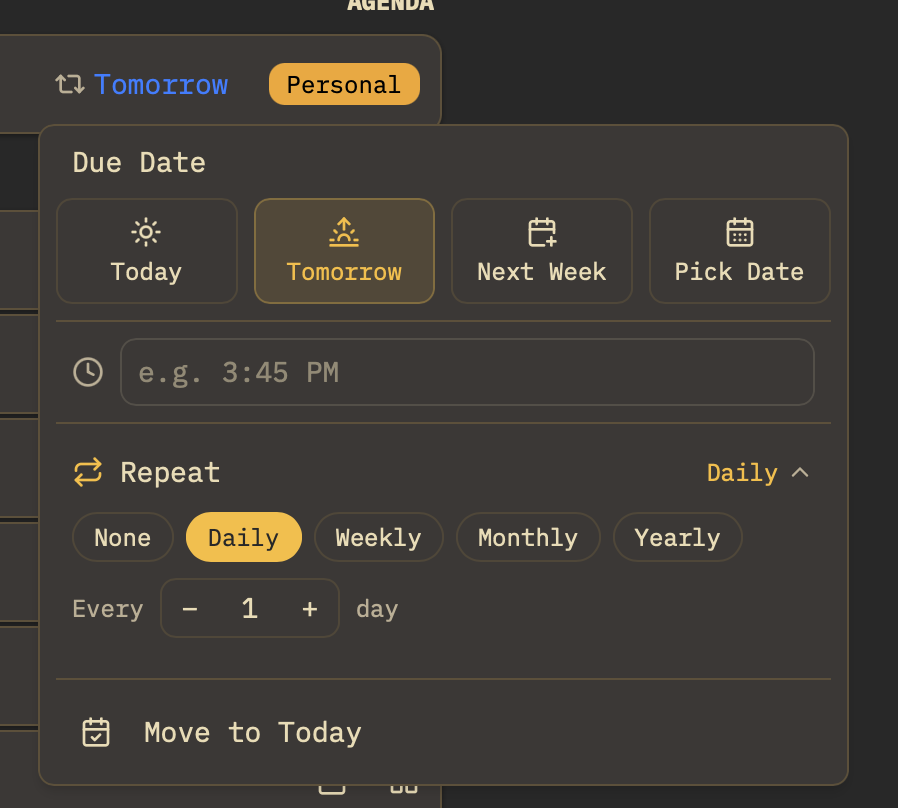
Owldo never shames you with punitive red badges or lost streaks. Unfinished tasks roll forward gracefully during your evening shutdown or morning planning routine.
How does the distinction between RAM and ROM help my daily focus?
It keeps your execution view pristine. You don’t have to wade through reference documents and long-term brainstorms just to see what code you need to write or what emails you need to send this morning.
More of our philosophy
The principles that guide how we design and build Owldo.

Philosophy
Capture fast. Organize later.
The app should act like an extension of your mind, not another thing to manage. Start messy, refine later.

Philosophy
Surface what matters now. Fade the rest.
Keep what’s recent, relevant, and repeated close at hand. The interface surfaces what matters now and fades the rest.

Philosophy
Opinionated workflows. Portable data.
Don’t create a system so inflexible it breaks when life changes. And when you outgrow us, export everything.